Skip to content

Select and compare

Video Glasses

At a glance

The key numbers for both devices side by side.

Overall rating
78Gut
75Gut
Value for money
71Fair
47Okay
Best price
€369.00
€568.00
Price advantage
€199.00 cheaper
—
Offers
1 shop
1 shop
Rank in category
Rank 7 of 10
Rank 8 of 10

Rating

Sub-ratings compared

RayNeo GTOverall rating 78Rokid Joy 2Overall rating 75
ImagequalityImagesize & edge sharpnessWearingcomfortCompatibility& setupFeaturesSoundBuildquality
RayNeo GTRokid Joy 2
Image quality83/10082/100
Image size & edge sharpness72/10064/100
Wearing comfort85/10080/100
Compatibility & setup71/10080/100
Features73/10062/100
Sound70/10062/100
Build quality81/10078/100
Image quality
83
82
Image size & edge sharpness
72
64
Wearing comfort
85
80
Compatibility & setup
71
80
Features
73
62
Sound
70
62
Build quality
81
78

Specs

Specs compared

Key specs

Model
GT
Joy 2
Field of viewDiagonal field of view (FOV) according to the manufacturer in degrees – the comparable value for image size, unlike the inch figure
46 degrees
50 degrees
TrackingHighest level at which the glasses anchor the image in space: 3DoF follows head rotation, 6DoF also movement through the room; “in the glasses” means with a built-in chip on any source device, without an app
3DoF in the glasses
BrightnessBrightness according to the manufacturer in nits (= cd/m²): the value at the eye (“perceived”), NOT that of the display itself (often 3,000 to 6,000 nits); if the manufacturer gives only one value without qualification, use that
1,200 cd/m²
600 cd/m²
WeightWeight of the glasses according to the manufacturer in grams, without cable, shade and prescription frame
68 g (2.4 oz)
75 g (2.6 oz)
For glasses wearersHow short-sighted users see sharply without their own glasses: insert frame for prescription lenses from an optician or adjustment wheels on the glasses themselves; choose the best available solution
Prescription frame (lenses from an optician)
Built-in diopter adjustment

Image & optics

OpticsType of optics that directs the image into the eye, according to the manufacturer: birdbath (semi-transparent mirror, usually thicker lenses) or flat prism (e.g. XREAL X-Prism)
Birdbath
Birdbath
Display technologyType of image source in the glasses according to the manufacturer (usually Micro-OLED from Sony or BOE)
Micro-OLED
Micro-OLED
Resolution per eyeDisplay resolution for ONE eye according to the manufacturer, not the sum of both eyes; if the manufacturer only delivers the higher resolution via an update, the advertised one
Full HD (1920 × 1080)
Refresh rateHighest refresh rate according to the manufacturer in Hz
120 Hz
120 Hz
HDR formatsHDR formats the glasses themselves display according to the manufacturer – even if this requires a source device from the manufacturer
Dolby Vision
DCI-P3 color gamut coverageCoverage of the DCI-P3 colour space according to the manufacturer in percent; leave empty if only sRGB is given
98 %
3D (side-by-side)According to the manufacturer, the glasses display 3D content in side-by-side format, one image per eye
Yes
Yes
Screen modesDisplay modes the glasses support themselves or with the manufacturer’s app, according to the manufacturer
Anchor image in space2D-to-3D conversion

Dimming

DimmingHow the surroundings behind the image can be blocked out: clip-on shade or electrically dimming lenses; choose the best available solution
Clip-on shade
Clip-on shade
Dimming levelsNumber of electric dimming levels according to the manufacturer, including “clear”; only for electrochromic lenses
0 levels
Automatic dimmingAccording to the manufacturer, the lenses dim automatically based on ambient light
No
No

Vision & fit

Correction up toStrongest short-sightedness the built-in adjustment corrects, as an absolute value in diopters: “0 to −6.0 dpt” becomes 6; only with built-in adjustment, none corrects astigmatism
6 dpt
Interpupillary distance adjustmentHow the glasses are adapted to the distance between the pupils: separate versions per size (S/M/L), image shifting via software or movable optics
Fixed sizes per version
Interpupillary distance (IPD)Suitable interpupillary distance according to the manufacturer in mm, e.g. “57–66 mm” or “under 64 mm” – for sizes S/M/L, enter per version
64 mm (fest)

Connection & features

Video inputHow the image gets into the glasses: USB-C with DisplayPort signal, HDMI only via a manufacturer adapter, or wirelessly
USB-C (DisplayPort)HDMI via adapter
USB-C (DisplayPort)
Detachable cableAccording to the manufacturer, the cable can be unplugged from the glasses and replaced
Yes
Yes
CameraAccording to the manufacturer, a camera is built into the glasses (photos, spatial recognition); a camera available only as an accessory does not count
No
Speaker tuningAudio partner according to the manufacturer, e.g. “Bang & Olufsen”, “Bose” or “Harman”; empty if none is named
Bang & Olufsen

General

Warranty
1 years
Price segment
Budget
Model year
2026
2024
In the box
Brille, USB-C-Kabel (DP), Etui, 2 Nasenpads, Korrekturrahmen-Muster, 4 Bügelpads, Putztuch, Anleitungen
Rokid Max 2 Brille, Rokid Station, Abdeckblende, USB-C-Kabel, Hartschalenetui, 2 Nasenpads

Prices

Offers

RayNeo GT

Rokid Joy 2

Ad · Links marked with * are affiliate links: if you buy through them, we earn a commission – at no extra cost to you.

Verdict

Pros & cons

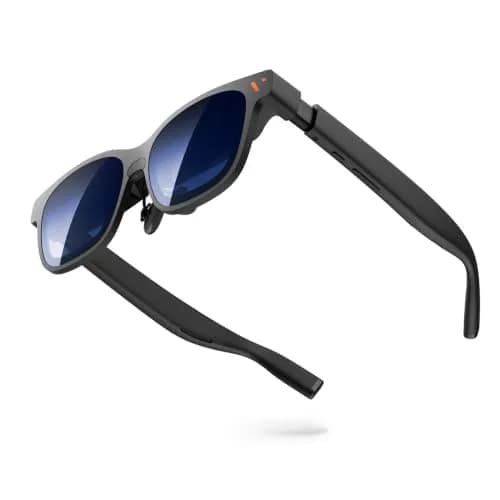
Die RayNeo GT ist eine leichte Videobrille mit sehr scharfem Micro-OLED-Bild, die das Bild per eingebautem 3DoF-Chip ohne App im Raum hält. Für Filme drinnen und Textarbeit am Laptop taugt sie gut, sofern dein Augenabstand nahe 64 mm liegt. Der Haken: Abdunklung und Dolby Vision nur mit Zubehör, bei Tageslicht überstrahlt die Umgebung das Bild.

Pros

  • Sehr scharfes Micro-OLED-Bild mit Full HD je Auge, Text gut lesbar
  • Eingebauter 3DoF-Chip hält das Bild ohne App, kein Driften dokumentiert
  • Mit 68 g leicht und über einen ganzen Film bequem
  • Hohe Pixeldichte von 49 Pixeln pro Grad für Webseiten und Dokumente
  • Abnehmbares Kabel und Korrekturrahmen für Gläser vom Optiker im Karton
  • Geringe Verzögerung am Steam Deck, direkt als Monitor nutzbar

Cons

  • Keine Abdunklung, Umgebungslicht überstrahlt das Bild bei Tageslicht
  • Optik fest auf 64 mm Augenabstand, ohne Auswahl an Größen
  • Dolby Vision nur mit separatem Pocket TV Pro
  • Im Pinned-Modus nur 336 cd/m² und schwarze Zwischenbilder
  • Bügel-Lautsprecher ohne Bass, Umgebung hört bei höherer Lautstärke mit

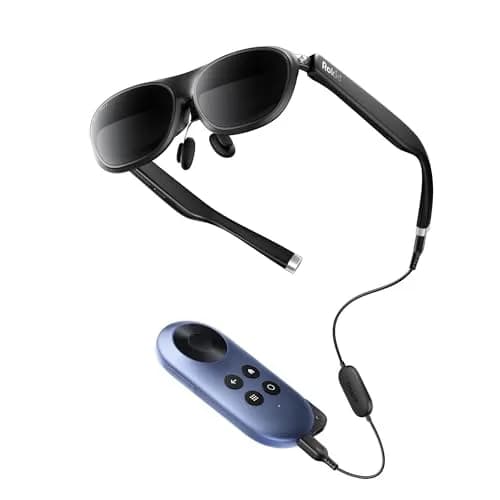
Die Rokid Joy 2 ist ein Set aus der leichten Videobrille Max 2 und einer Android-TV-Station und ein gutes Kino für unterwegs. Die Brille wiegt 75 g und zeigt je Auge ein scharfes Full-HD-Bild mit 120 Hz. Die Station spielt Filme auch ohne Handy ab. Der Haken: An den Rändern wird das Bild weich, deshalb taugt es nicht für Tabellen und Texte. Außerdem klingen die Lautsprecher dünn.

Pros

  • Micro-OLED mit Full HD je Auge und 120 Hz, tiefes Schwarz ohne Pixelraster
  • 75 g leicht, ein ganzer Spielfilm ohne Druckstellen an Nase und Ohren
  • Station mit Android TV spielt Filme ohne Handy und versorgt die Brille mit Strom
  • Dioptrien-Rädchen je Auge gleichen Kurzsichtigkeit bis −6 dpt aus
  • Abnehmbares USB-C-Kabel, bei Defekt lässt es sich einzeln ersetzen
  • 3D im Side-by-Side-Format ohne Shutterbrille

Cons

  • Bildränder und Buchstabenkanten weicher als die Mitte, schlecht für Textarbeit
  • Lautsprecher klingen dünn, ohne Bass und sind im Zug zu leise
  • Keine elektrische Abdunklung, nur eine lose Aufsteckblende
  • Station mit älterem Android TV, nicht jede Streaming-App verfügbar
  • Bei großen Köpfen sitzt die Brille straff und lässt sich schwer zurechtrücken

Spotted an error?

Wrong price, wrong spec or a dead link – let us know and we will fix it quickly.

Report an error

Similar comparisons

RayNeo GTRayNeo GT78
RayNeo GT MaxRayNeo GT Max81
View comparison
RayNeo GTRayNeo GT78
XREAL 1 Pro+XREAL 1 Pro+81
View comparison
RayNeo GTRayNeo GT78
XREAL 1SXREAL 1S82
View comparison
RayNeo GTRayNeo GT78
VITURE Pro 2VITURE Pro 274
View comparison

Keep reading

What’s next?

Maybe a different type of device?

Same kind of training, different devices – one click away.

Build your own comparison