- Care & Maintenance
- How-to
Setting up and maintaining your treadmill: making it last
The right location, an aligned running surface, and regular care determine how long a treadmill runs quietly and without problems.
 AuthorJonas Bergmann
 2 min read
 See us more on Google
Key takeaways
- A firm, level surface and space to step off all around – with the most room behind the device.
- Check belt tension and alignment before adjusting: a quarter turn is usually enough.
- Lubricate and clean according to the intervals in the instructions, not by feel.
The right location
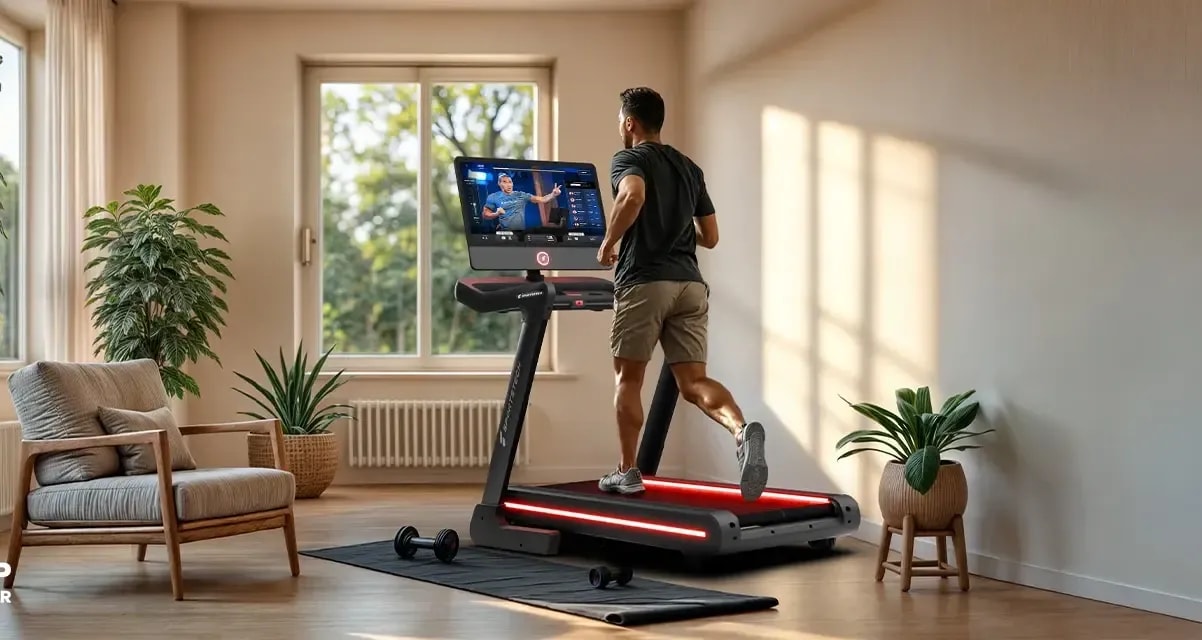
A treadmill is heavy and operates with a running belt – neither forgives a wobbly surface. It's therefore worth examining the location seriously before unpacking: the floor must be level and sturdy, and the device must not wobble during startup. On carpet, lint collects in the motor compartment; on smooth parquet, a mat underneath protects against pressure marks and also dampens some of the footfall noise.
Just as important is the clearance all around. You need the greatest amount of space behind, because if you stumble, you'll be carried backward. On the sides, you should be able to step off easily without hitting a wall or furniture.
Space requirement as a guideline
2 m
free space behind the device
60 cm
free space on both sides
level floor
No wobbling when starting
Mat
Protects the floor and cushions
The first steps after assembly
New devices come with factory-set belt tension, which settles during the first few hours of operation. A quick check is therefore part of the routine once the treadmill has covered a few kilometers.
- Belt tracking:If the belt visibly runs to one side at low speed, the tension is uneven. Always readjust in small steps – a quarter turn on the screw of the deviating side is usually enough.
- Tension:If the belt slips briefly when you step on it, it is too loose. Tighten both screws evenly, then test it again.
- Screws:Retighten the handrail and frame connections after the first few weeks. A creak is more often caused by a loose screw than by the motor.
Maintenance that is truly necessary
The maintenance effort is manageable, but the interval is not arbitrary: how often a treadmill needs to be lubricated depends on the model and is stated in the manual – often as a number of operating hours. Many devices now report this automatically on their display. Anyone who lubricates by feel instead risks both: a dry run that stresses the belt and motor, or an excess that collects dust.
What to do when
| Task | When |
|---|---|
| Wipe down the running surface and side rails | Briefly after each workout, damp without cleaner |
| Vacuum under the device | weekly – dust is the most common culprit |
| Lubricate the deck | according to the interval in the instructions or on the display |
| Check belt tension and tracking | monthly and after every move |
| Retighten screws | every few months, especially with folding frames |
Frequently asked questions
Can a treadmill be placed on carpet?
Low-pile carpets are fine if you vacuum under the device regularly. High-pile carpet is not good: it blocks the air vents and fibers get into the motor compartment. A solid mat underneath solves the problem.
How do I know when the belt needs to be lubricated?
Typical signs are a louder, grinding running noise and a running surface that feels dry and warm after a workout. But don't just rely on that – follow the interval in the manual, and many devices remind you on their own.
Do I have to fold up a folding treadmill after each workout?
It's not necessary. If you train daily, it's better to leave it up: every fold cycle puts stress on the joint and lock. Fold it up when you need the space – and make sure the lock audibly clicks into place.
Share article
About the author

Fitness editor
Jonas looks after the fitness guides at cybermag – from treadmills and walking pads to rowing machines, ellipticals and smart gyms. His focus: honest, data-driven buying advice without marketing hype.
Facts checked and approved for publication by Jonas Bergmann · as of August 27, 2026 · How our texts are written →